
Library Foundation as a Strategic Asset
![]() Library Foundation as a Strategic Asset
Library Foundation as a Strategic Asset
What Strong Public Library Foundations Look Like
Public library foundations play an increasingly vital role in helping their libraries adapt to a changing world. Some foundations serve primarily as fundraising vehicles. Others become something more: strategic partners that expand a library’s impact, strengthen its visibility, and help ensure long-term sustainability.
The Library Support Network has been developing a framework that describes what a foundation looks like when it becomes strategic. It is not a checklist and not a maturity model. Instead, it highlights the conditions, habits, and strengths that consistently appear in foundations that elevate what their libraries can accomplish.
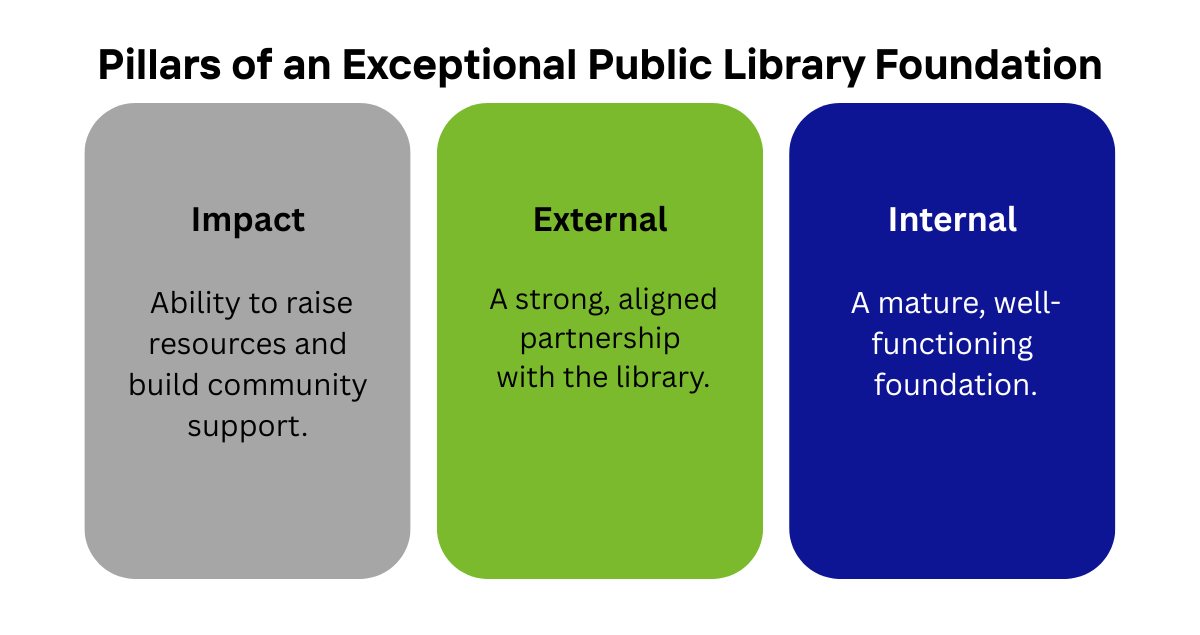
This framework is organized around three pillars, each supported by a set of hallmarks. Together, they describe the character of a foundation that delivers meaningful, lasting value to its library and community.
Pillar One: Community Impact and Public Value
A strategic foundation strengthens how the library serves the community.
Every strong foundation begins with a clear understanding of why it exists: to expand the library’s ability to improve lives. The starting point is not dollars raised but the difference those dollars make. Foundations that operate as strategic assets share several characteristics tied to impact and public value.
1. Centered on Community Benefit
The foundation understands the library’s larger purpose in the community and works to amplify that purpose. Investments are connected to real community needs, not just internal priorities or donor interests. Impact is defined by outcomes, not simply outputs.
2. Aligned with the Library’s Mission and Priorities
A strategic foundation aligns its work with the library’s goals for learning, access, connection, and community wellbeing. It plays a supporting role, helping the library pursue bigger ideas, reach more people, or accelerate plans that would not be possible with public funding alone.
3. Makes Impact Visible
These foundations help the public understand why the library matters. They elevate stories of transformation, share evidence of community outcomes, and increase awareness of the library’s essential role. This visibility supports both philanthropic confidence and public support for the library as an institution.
4. Demonstrates Accountability
Strategic foundations articulate the results of the work they support. They communicate what philanthropy makes possible, what has been learned, and how the community benefits. This strengthens trust with donors, partners, and the library itself.
Pillar Two: External Influence and Partnership
A strategic foundation strengthens relationships, trust, and the library’s position in the community.
Strong foundations do not operate on the margins. They serve as ambassadors, partners, and connectors between the library and its broader community. They build networks of support that extend well beyond fundraising.
5. A Trusted Partnership with Library Leadership
The relationship between the foundation’s executive leader and the library’s director is open, candid, and grounded in shared purpose. There is clarity about roles, mutual respect for institutional constraints, and regular communication. When this relationship is strong, the entire ecosystem benefits.
6. A Shared Vision for Success
The library and foundation work from a common understanding of long-term goals. Even when strategies differ, the two organizations can articulate what they are trying to accomplish together and why. This shared vision reduces friction and allows both organizations to work with greater confidence.
7. Advocacy and Public Voice
Strategic foundations help the library tell its story in the community, build goodwill, and engage civic partners. They act as trusted champions who can translate the library’s value to different audiences, from donors to policymakers. They understand that public and private support reinforce each other.
8. Donor Engagement and Stewardship
Foundations that operate as strategic assets build strong, long-term donor relationships grounded in transparency and mutual respect. Their fundraising is tied to mission and donors understand the difference their support makes and feel connected to the work they enable.
Pillar Three: Internal Strength and Sustainability
A strategic foundation operates with clarity, capacity, and long-term stability.
Behind every strong foundation is a set of internal conditions that allow it to deliver results consistently. These are not the visible elements of the work, but they form the structure that makes excellence possible.
9. Effective Governance and Board Leadership
The board provides direction, oversight, and connection to community networks. It governs at the right altitude, stays focused on mission and strategy, and understands the unique role of a library foundation. Board members act as ambassadors and bring relationships that strengthen the institution.
10. Skilled Staff and Operational Capacity
Strategic foundations invest in qualified staff and the systems that support them. They view operational strength not as overhead but as essential capacity. This includes strong financial management, effective communication tools, reliable donor systems, and clear internal processes.
11. Financial Sustainability
These foundations look beyond the current year to ensure long-term resilience. They maintain diversified revenue streams, appropriate reserves, and transparent financial practices that reinforce donor trust. Sustainability allows the foundation to support the library in both stable and uncertain times.
12. A Culture of Learning and Renewal
Strong foundations are adaptive. They reflect on their work, seek feedback, and adjust their approach when needed. They plan for leadership transitions and maintain institutional memory so that mission continuity does not depend on any one individual.
Why These Characteristics Matter
When a foundation demonstrates these pillars and hallmarks, it becomes more than a mechanism for raising funds. It becomes a force that strengthens the library’s relevance, expands its reach, and fortifies its ability to meet community needs.
This is what it looks like when a foundation becomes strategic:
- The library has a trusted partner who helps anticipate challenges and seize opportunities.
- Donors have confidence that their philanthropic investments are meaningful and well-stewarded.
- The community benefits from a library that is more visible, more adaptable, and more equipped to serve.
- The foundation itself operates with clarity, purpose, and long-term stability.
This framework reflects what the Library Support Network has learned through its work with libraries and foundations across North America. It is offered as a tool to help boards, staff, and library leaders understand the possibilities for their own organizations and imagine what can be achieved when a foundation is positioned to be a true strategic asset.
A framework developed by the Library Support Network